A Comparative Morphological and Histological Study of the Tongue between African grey parrot and the black crow (Corvus capensis)
Article Sidebar
Main Article Content
Abstract
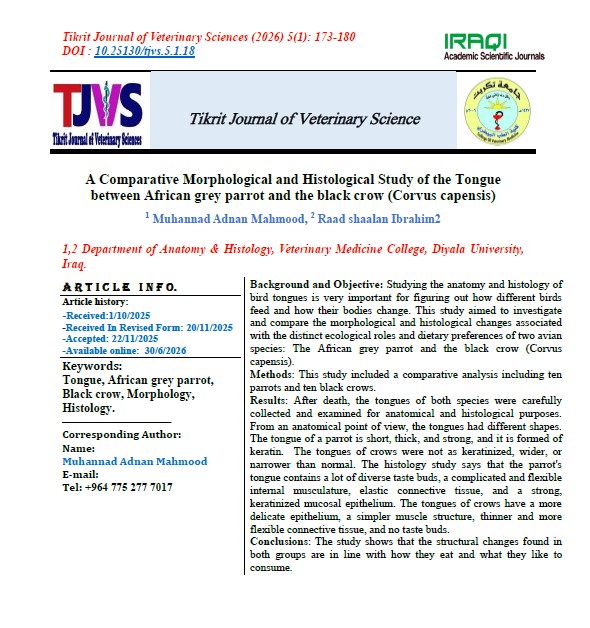
Background and Objective: Studying the anatomy and histology of bird tongues is very important for figuring out how different birds feed and how their bodies change. This study aimed to investigate and compare the morphological and histological changes associated with the distinct ecological roles and dietary preferences of two avian species: The African grey parrot and the black crow (Corvus capensis).
Methods: This study included a comparative analysis including ten parrots and ten black crows.
Results: After death, the tongues of both species were carefully collected and examined for anatomical and histological purposes. From an anatomical point of view, the tongues had different shapes. The tongue of a parrot is short, thick, and strong, and it is formed of keratin. The tongues of crows were not as keratinized, wider, or narrower than normal. The histology study says that the parrot's tongue contains a lot of diverse taste buds, a complicated and flexible internal musculature, elastic connective tissue, and a strong, keratinized mucosal epithelium. The tongues of crows have a more delicate epithelium, a simpler muscle structure, thinner and more flexible connective tissue, and no taste buds.
Conclusions: The study shows that the structural changes found in both groups are in line with how they eat and what they like to consume.