Revealing the effect of bromelain and donepezil against scopolamine-induced behavioral and histological changes in the brain
Article Sidebar
Main Article Content
Abstract
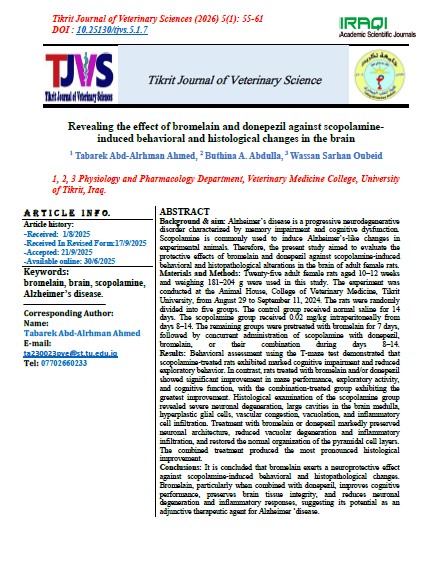
Background & aim: Alzheimer’s disease is a progressive neurodegenerative disorder characterized by memory impairment and cognitive dysfunction. Scopolamine is commonly used to induce Alzheimer’s-like changes in experimental animals. Therefore, the present study aimed to evaluate the protective effects of bromelain and donepezil against scopolamine-induced behavioral and histopathological alterations in the brain of adult female rats.
Materials and Methods: Twenty-five adult female rats aged 10–12 weeks and weighing 181–204 g were used in this study. The experiment was conducted at the Animal House, College of Veterinary Medicine, Tikrit University, from August 29 to September 11, 2024. The rats were randomly divided into five groups. The control group received normal saline for 14 days. The scopolamine group received 0.02 mg/kg intraperitoneally from days 8–14. The remaining groups were pretreated with bromelain for 7 days, followed by concurrent administration of scopolamine with donepezil, bromelain, or their combination during days 8–14.
Results: Behavioral assessment using the T-maze test demonstrated that scopolamine-treated rats exhibited marked cognitive impairment and reduced exploratory behavior. In contrast, rats treated with bromelain and/or donepezil showed significant improvement in maze performance, exploratory activity, and cognitive function, with the combination-treated group exhibiting the greatest improvement. Histological examination of the scopolamine group revealed severe neuronal degeneration, large cavities in the brain medulla, hyperplastic glial cells, vascular congestion, vacuolation, and inflammatory cell infiltration. Treatment with bromelain or donepezil markedly preserved neuronal architecture, reduced vacuolar degeneration and inflammatory infiltration, and restored the normal organization of the pyramidal cell layers. The combined treatment produced the most pronounced histological improvement.
Conclusions: It is concluded that bromelain exerts a neuroprotective effect against scopolamine-induced behavioral and histopathological changes. Bromelain, particularly when combined with donepezil, improves cognitive performance, preserves brain tissue integrity, and reduces neuronal degeneration and inflammatory responses, suggesting its potential as an adjunctive therapeutic agent for Alzheimer ‘disease.