Histological Changes Associated with Exposure to Lead Acetate and Evaluation of the Therapeutic Role of Berbin Extract in Female Albino Rats and Their Fetuses
Article Sidebar
Main Article Content
Abstract
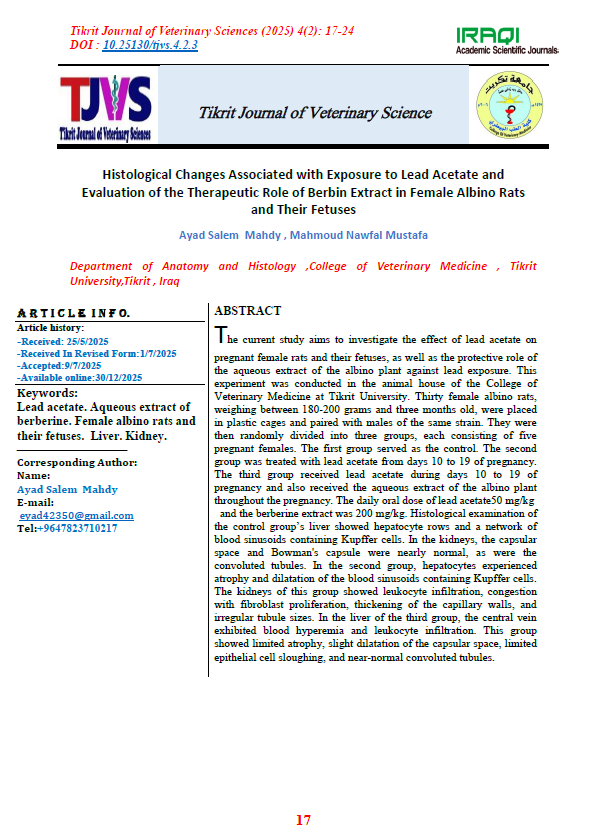
The current study aims to investigate the effect of lead acetate on pregnant female rats and their fetuses, as well as the protective role of the aqueous extract of the albino plant against lead exposure. This experiment was conducted in the animal house of the College of Veterinary Medicine at Tikrit University. Thirty female albino rats, weighing between 180-200 grams and three months old, were placed in plastic cages and paired with males of the same strain. They were then randomly divided into three groups, each consisting of five pregnant females. The first group served as the control. The second group was treated with lead acetate from days 10 to 19 of pregnancy. The third group received lead acetate during days 10 to 19 of pregnancy and also received the aqueous extract of the albino plant throughout the pregnancy. The daily oral dose of lead acetate50 mg/kg and the berberine extract was 200 mg/kg. Histological examination of the control group’s liver showed hepatocyte rows and a network of blood sinusoids containing Kupffer cells. In the kidneys, the capsular space and Bowman's capsule were nearly normal, as were the convoluted tubules. In the second group, hepatocytes experienced atrophy and dilatation of the blood sinusoids containing Kupffer cells. The kidneys of this group showed leukocyte infiltration, congestion with fibroblast proliferation, thickening of the capillary walls, and irregular tubule sizes. In the liver of the third group, the central vein exhibited blood hyperemia and leukocyte infiltration. This group showed limited atrophy, slight dilatation of the capsular space, limited epithelial cell sloughing, and near-normal convoluted tubules.